
Everyone loves the sound of a warm, full chord voicing.
The C6 neck makes this especially easy to access. With its low-end depth and intuitive interval layout, it naturally lends itself to chord voicings that feel wide, rich, and musical.
The 10th string alone can rival a bass guitar’s range, and when you combine that with higher strings, you start to get a sound that feels closer to a blend of bass, guitar, and keyboard all at once.
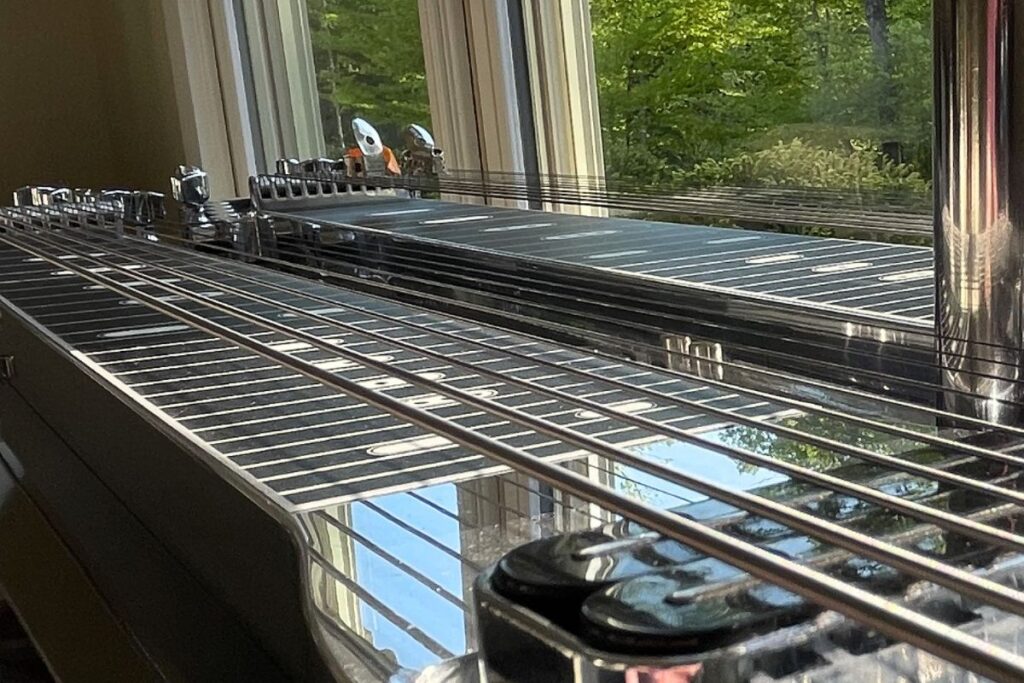
Three Bluesy Dominant 7 Voicings
Below are three different voicings for a dominant 7 chord that work well in blues, jazz, and rock settings.
These are designed to be used together.
They all sit in the same general position, which makes it easy to switch between them while playing. The difference between them comes mostly from the top notes, which creates variation without needing to move far on the neck.
Voicing #1

These voicings share a consistent approach:
- The 10th string provides the root (in this case, F)
- The overall shape stays compact
- Each grip uses three fingers
Not every voicing includes the flat 7 directly, but the overall sound still strongly implies a dominant quality, especially in a band setting.
Voicing #2

Once this position feels comfortable, you can begin moving it through a progression.
For example, in the key of F:
- Move to the 10th fret for the IV7 chord
- Move to the 12th fret for the V7 chord
This allows you to stay within the same set of shapes while outlining a full blues progression.
Voicing #3

At this point, the goal is to move between all three voicings fluidly.
Instead of thinking of them as separate chords, start hearing them as variations of the same harmonic idea. That’s where the musical value really opens up—small changes in voicing create movement without needing large position shifts.
How to Work These Into Your Playing
The real benefit of these voicings comes from switching between them naturally.
Try:
- Alternating between voicings on the same chord
- Moving all three shapes through a simple I–IV–V progression
- Letting chords sustain while adjusting your top note choices
This kind of movement is a big part of what gives C6 its depth, and it becomes easier to recognize once you spend time understanding how the C6 tuning is organized across the neck.
Picking and Control
To bring out the clarity in these voicings, your picking hand needs to stay controlled and relaxed.
Because these chords span a wider range, blocking becomes important for keeping the sound clean—especially when switching between grips.
That control tends to improve naturally as your right hand blocking becomes more consistent over time.
Taking This Further
Once these voicings start to feel comfortable, the next step is recognizing where similar shapes show up in other parts of the neck and how they connect to each other.
That becomes much easier when you spend time understanding how the C6 tuning is laid out, since many of these chord ideas repeat in different positions.