There’s nothing like a full, big-sounding chord on the C6 neck.
Combine that with sustain from the volume pedal, a bit of reverb, and some vibrato, and you start to hear why this tuning is known for its rich, piano-like sound.
A Set of Big-Sounding C6 Chord Voicings
The diagram below shows a group of chord voicings that sit well on the C6 neck and translate easily across the fretboard.
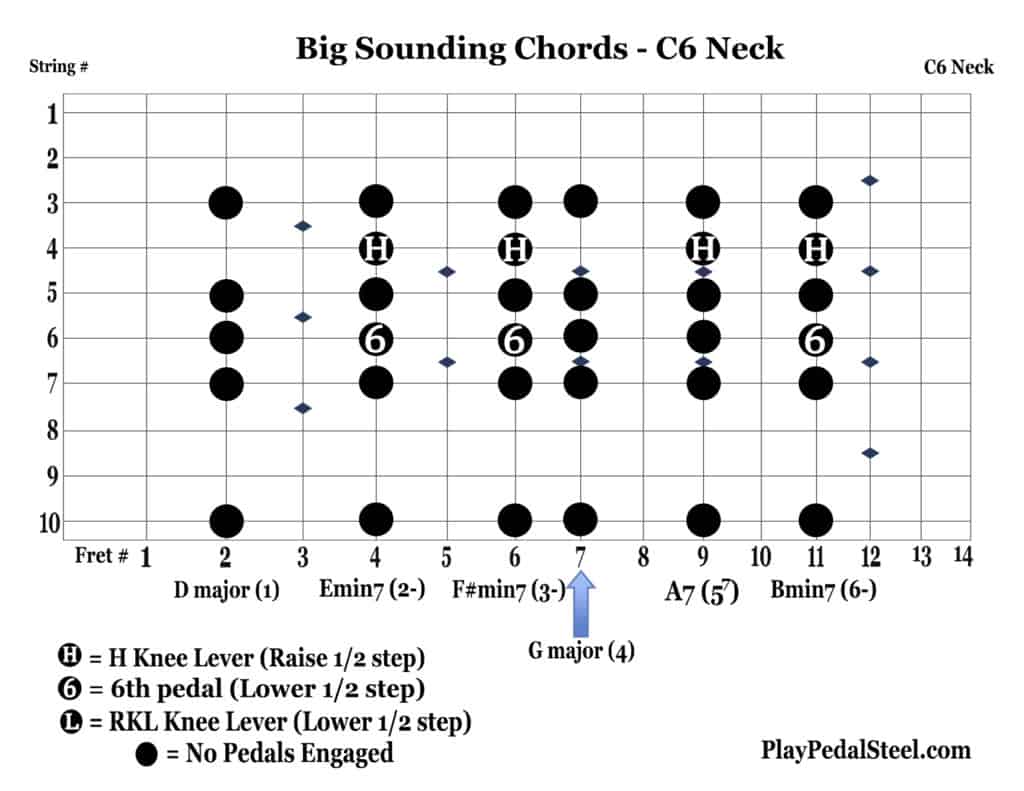
These all share a common layout, which makes it easier to move between them once you get comfortable with the shape.
How These Chords Are Organized
All of these voicings have their root on the 10th string (and reinforced on the 7th string), which gives them a strong low-end foundation.
Because of that, you can move the entire shape up and down the neck to follow a progression, while keeping the same overall sound and spacing.
The Nashville Number System included in the diagram helps show how these chords relate to each other within a key, which becomes much easier to recognize once you spend time with how the C6 tuning is laid out.
Picking Approach for These Voicings
To bring out the full sound of these chords, it helps to approach the picking in a consistent way.
A simple way to work through them:
- Use your thumb for the 10th string
- Follow with the thumb again across strings 7–5
- Use your index and middle fingers for strings 4 and 3
You can also separate the low root note slightly from the rest of the chord to give it more definition.
This kind of control becomes easier as your picking hand settles in, especially when your right hand blocking starts to feel more natural and consistent.
What to Listen For
As you play through these, focus on how the voicings fill out the frequency range.
They tend to sound closer to an organ or piano than a typical guitar chord, especially when you let them sustain and use subtle volume pedal movement.
You’ll start to hear how these shapes can sit underneath a band or carry a progression on their own.
Applying These Across the Neck
Once the shape feels comfortable, try moving it through a simple progression.
Even something like I–IV–V will start to feel more connected when you stay within the same grip and move it along the fretboard.
This is one of the advantages of the C6 neck—many musical ideas become easier to follow once you recognize where the shapes repeat.
Taking This Further
Seeing how these kinds of chord shapes move and relate across the neck becomes much easier once you’ve spent time with The Chord Guide for E9 Pedal Steel, even though it focuses on the E9 tuning. The way it breaks down chord relationships and movement translates directly to how you start thinking about shapes on C6.