As an Amazon Associate Playpedalsteel.com earns from qualifying purchases. This page contains affiliate links.
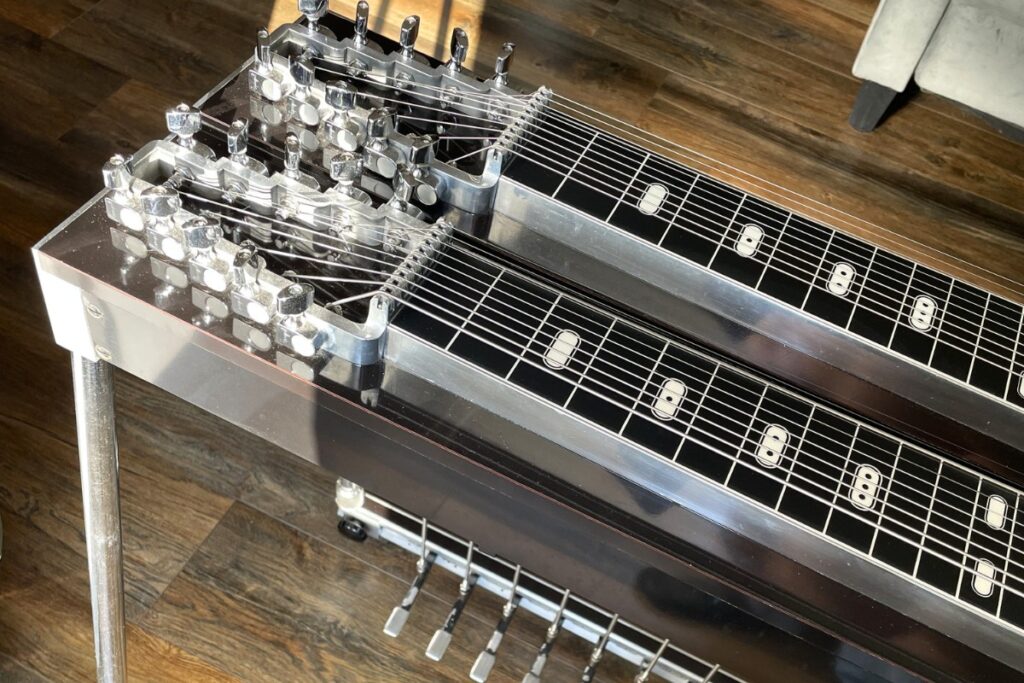
Most pedal steel guitars have the unique ability to be set up in different ways depending on how the pedals and knee levers are arranged. These configurations are commonly referred to as copedents, and for the E9 neck, the two most widely used setups are the Emmons setup and the Day setup.
The main difference between them comes down to how the pedals are arranged under your left foot. That one change affects how your foot moves, how combinations feel, and how you develop technique over time.
What Is a Day Setup?
The Day setup is a variation of the standard E9 pedal layout where the positions of the A and C pedals are reversed compared to the Emmons setup.
On a Day setup:
- The pedal that raises the B notes to C# is in the third position
- The pedal that raises the E and B strings is in the first position
- The B pedal (G# to A) stays in the middle position
This means your foot movement pattern is different, even though the musical result is the same.
Understanding how these pedal changes function becomes much clearer when you look at how notes are altered across the tuning, especially as you get more familiar with how the E9 tuning is laid out across the neck.
Why Is It Called the Day Setup?
The Day setup is named after Jimmy Day, one of the most influential pedal steel players in the instrument’s history.
He preferred this pedal arrangement, and over time other players adopted it. Eventually, manufacturers began offering it as a standard configuration option alongside the Emmons setup.
Both setups became widely used, and neither one is inherently better—it’s simply a different way of approaching the same musical system.
How It Compares to the Emmons Setup
The difference between Day and Emmons setups is purely physical, not musical. The same chords, scales, and movements are available on both.
What changes is how your foot interacts with the pedals.
Most players find the Emmons setup more intuitive at first, especially when rocking between the A and B pedals. However, others find that the Day setup feels more natural once they spend time with it.
This comes down to how your body moves, not which system is objectively better.
Developing smooth control here is tied directly to how efficiently your foot moves across the pedals, which is a big part of building consistency with left foot pedal technique on pedal steel.
What Is the Full Copedent?
A copedent is the full map of how each pedal and knee lever affects the strings.
Both Day and Emmons setups use nearly identical copedents—the only difference is the order of the pedals.
Getting familiar with how these changes are organized helps everything make more sense as you play, especially when you start connecting positions and chord movement across the instrument.
That broader view becomes much clearer when you understand how pedal steel copedents are laid out and used in real playing situations.
Why Choose the Day Setup?
There are a few reasons someone might choose the Day setup:
- It feels more natural under their foot
- They started on it and developed muscle memory early
- They’re influenced by players who used it
At the end of the day, your body adapts to whichever setup you commit to.
If you start on one and stay consistent, it will feel natural over time.
For most players, the biggest factor isn’t which setup they choose—it’s how much time they spend developing control and consistency with it.
Pros and Cons of the Day Setup
Pros
- Can feel more natural depending on foot movement
- Works equally well for all musical applications
- Strong historical connection to influential players
Cons
- Less common than Emmons, especially on used guitars
- May feel unfamiliar if you learned on Emmons first
- Requires adjustment if switching between setups
Can You Switch Between Setups?
Yes, but it’s not always simple.
Switching between Day and Emmons setups requires retraining your foot movement patterns. Even though the notes are the same, your muscle memory has to adapt.
For most players, it’s better to commit to one setup early and build consistency over time.
That consistency becomes especially important when you’re combining pedals with picking and blocking, where timing and coordination all need to line up together.
Where to Find Pedal Steels With a Day Setup
Most modern builders can set up a pedal steel with the Day configuration if requested.
If you’re buying used, you’ll likely see more Emmons setups on the market, but Day setups still come up regularly.
Understanding what to look for when buying makes a big difference here, especially when you’re comparing options, features, and condition across instruments.
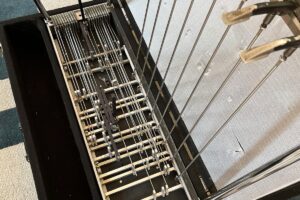
If you already have a guitar with an Emmons setup, it can often be converted to a Day setup by a qualified technician.
This involves reconfiguring the pedal rods and possibly making adjustments to the undercarriage.
If you’re considering that route, it helps to understand how pedal steel repair and setups work in general before making the change.
Conclusion
The Day setup is simply a different way of arranging the same musical system.
Whether you choose Day or Emmons, what matters most is how comfortable and consistent you become with it over time.
Once your foot movement becomes natural, the setup itself fades into the background, and your focus shifts to making music.
Taking This Further
Getting comfortable with either setup becomes much easier when you can clearly see how chords and pedal combinations connect across the neck in real playing situations.
That connection tends to click faster when you spend time with The Chord Guide for E9 Pedal Steel, especially as you start recognizing how pedal movement shapes harmony across different positions.
As your control improves, hearing how these pedal combinations show up in actual phrases helps everything feel more musical, and working through ideas in 200 Country Riffs & Licks for E9 Pedal Steel is a natural way to apply that movement in context.
If you want to refine how your foot movement, timing, and coordination are developing, those details tend to come together much faster through one-on-one pedal steel lessons.